Fujifilm GFX100RF Review
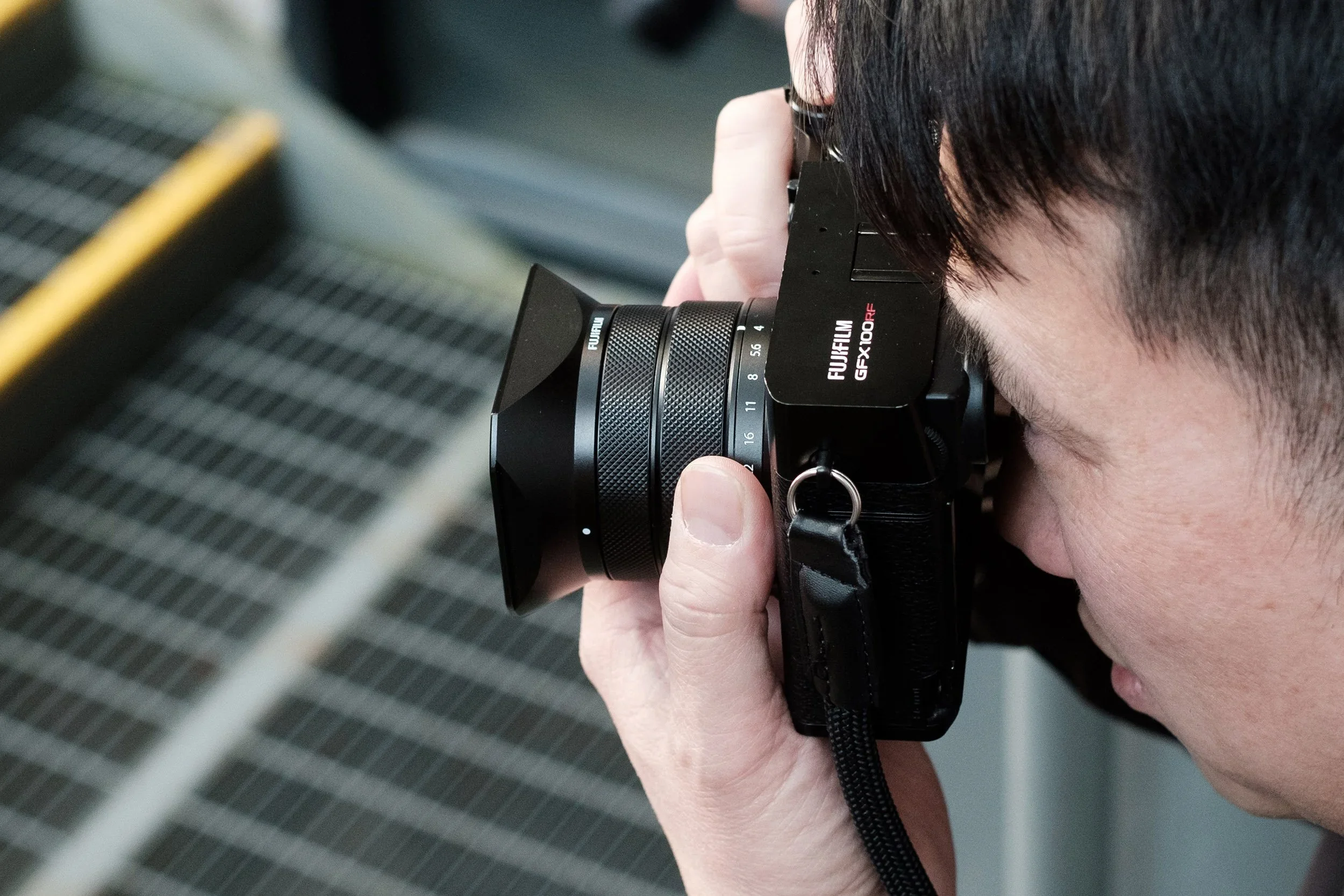
The Fujifilm GFX100RF, and Billy Luong in Vancouver
This Review is a result of two tests of the Fujifilm GFX100RF. In April of 2025, I attended a “First Look” event in Vancouver, and Fujifilm Canada sent me a loaner GFX100RF, which I had over the holiday period 2025-26.
I have left my first impressions in place, and my updates, after having the camera for a more extended period, will follow each section.
Fujifilm GFX100RF First Look
Fujifilm Canada and Beau Photo hosted a first-look event for the Fujifilm GFX100RF at Granville Island in Vancouver in April of 2024.
Everything was well set up; each participant had a GFX100RF for about an hour. After a brief introduction, we could join a photo walk or roam Granville Island for a few first impressions of the new fixed-lens GFX camera.
Fujifilm GFX100RF
Background Info, GFX100RF Introduction
I have tried all GFX cameras at some point, except the GFX100, and I used the GFX 50R extensively for about a year. I have also tested almost every available Fujifilm GF lens.
I have used many X-Series cameras, especially the X-Pro1, X-Pro2, and X-Pro3. I have used these for everything from pro gigs to landscapes, but mainly for travel and street photography. The camera links above go to my reviews.
The Fujifilm GFX100RF appeals to me for its size, weighing only 1.6 lb (735 g). That is almost exactly the same as my X-Pro2 and XF 35mm f/1.4 R camera/lens combination, which I took to nearly all fifty countries for our travel project.
In this review, I will have three sections:
The Exciting
The Less Than Exciting
The Concerns
Granville Island, Fujifilm GFX100RF @ f/5.6, minor crop when straigtening
The Exciting
Looking at the GFX100RF, I am most excited about the instant familiarity and similarity to my X-Pro cameras. I will get to the larger sensor later.
I don’t like cameras that are too small, nor do I want them to be too heavy or bulky. Ever since I first held the X-Pro1, I have found this line of cameras to be the perfect size and weight.
I realize the X-Pro cameras are interchangeable lens cameras. Still, as mentioned above, the GFX100RF is similar in size and weight, which is incredible for a camera featuring a sensor four times the size of the APS-C sensors found in the X-Pro cameras. And the GFX100RF includes a lens!
I was concerned that the handling would differ from that of the X-Pro cameras, as the body is taller and slightly thicker, but there was no need to worry. The camera feels great in the hand, and the grip helps you get a good handle on things.
False Creek, Vancouver, Fujifilm GFX100RF @ f/8
The GFX100RF gets the newer, larger NP-W235 battery, which is rated for 820 shots. It makes for a slightly thicker body, but doesn’t feel vastly different from my X-Pro2.
The GFX100RF has two SD card slots, which is essential if you use the camera for professional gigs where a backup can be crucial. In comparison, the Leica Q3 only has one card slot.
The EVF is excellent! It’s sharp, vibrant, and has adequate resolution. It is undoubtedly a highlight of the GFX100RF.
Update: After using the GFX100RF for a few weeks, it has been an absolute joy to use due to the portability, as mentioned above. I have cycled and walked, and the reality is it hardly feels different from an X-Pro camera, which is incredible.
Fujifilm X-Pro2 and GFX100RF size comparison
Image Quality
In the first batch of photos from the GFX100RF, I am in awe of the image quality, especially the uncropped 35mm (28mm full-frame equivalent) images.
If you crave the ultimate image quality and appreciate the ability to crop, the GFX100RF is for you.
While the ability to crop is there, I would only use it when needed. You cannot compare it to using a variety of lenses, which will introduce different compression at longer focal lengths, nor will the roll-off effect look the same.
Please check the two images below. First, a photo showing the crop, then the edited image, cropped to roughly 20% of the original.
Update: After more prolonged use, my suspicion was confirmed. I much prefer the uncropped images from the GFX100RF. Don’t get me wrong, you can crop to your heart's content, but the pinnacle quality remains if you only do so sparingly.
The original image shown with the crop lines
An extensive crop, 20%, on the Fujifilm GFX100RF
The Less Than Exciting
While some photographers will love the aspect ratio dial and digital crop function, I will put these in my category of what I am less excited about. I find the implementation nearly flawless with an easy-to-reach dial, but I am not sure I would use it much.
I see the benefit of previewing different aspect ratios, but after the novelty period, I would gradually do so in post-production. While the aspect ratio dial works well, I find it an eyesore on the back of the camera. I would have preferred a custom button for this.
Fujifilm GFX100RF
The same could be said about the lever on the front for the digital zoom. Removing them would make the camera look even more streamlined, which would be more important to some of us. It is so easy to bump the digital zoom lever on the front of the camera, which can be a tad frustrating if you don’t intend to.
Update: I didn’t use the aspect ratio dial at all during my second try with the GFX100RF. I did crop a few images in post to 3 x 2 and, in one case, to the 65 x 24 aspect ratio. However, if you are a JPEG shooter, you can have a lot of fun with this, and it may streamline the workflow to your liking. If you shoot RAW and JPEG, you could have the best of both worlds.
English Bay, Vancouver, Fujifilm GFX100RF @ f/5.6, cropped to the 65 × 24 aspect ratio
The Lack of Image Stabilization, IBIS
The GFX100RF lacks in-body image stabilization (IBIS), which is a concern to a certain degree. My minimum allowed shutter speed (auto ISO) was 1/40s for the first few shots of the day during my first test, resulting in some blur (possibly motion blur during the portrait session).
I know the benefits of IBIS, but I have to mention the X-Pro2 again, which I have taken worldwide. Perhaps by a miracle, I came home with thousands of great shots and never really missed image stabilization.
The leaf shutter in the GFX100RF reduces camera shake compared to a traditional focal-plane shutter, and the 102-megapixel sensor's ISO performance is quite good. This should take some of the worry out of shooting at higher ISO values, and to a degree, it does.
For travels, I would usually bring a Manfrotto mini tripod or a lightweight BeeFree tripod to stabilize the camera for evening shots or long-exposure photography. All photos in this review were captured hand-held.
Update: During my second run with the GFX100RF, I was out in the evening and at dusk, and the camera performed admirably at higher ISO values (1600-3200). I didn’t push my luck further.
But admittedly, IBIS would have been excellent to have with this camera. I had a few frames, shot at 1/40s, where camera shake was noticeable. With IBIS, it wouldn’t have been the case.
West End Vancouver, Fujifilm GFX100RF @ f/4, ISO 1600, 1/40s
Autofocus
While autofocus speed is more than adequate for the types of images you see in this review, if you use a single point and recompose, the eye-detect AF still feels a bit average, and it's faster on my Nikon Z6 III and, dare I say, my Leica SL2-S with its contrast-detect AF.
It works okay on the GFX100RF, but only sort of. There are noticeable delays, and some hunting is going on.
Blackout Time
I will also mention the blackout time in the list of things I am less excited about. While the leaf shutter is stealthy and quiet, there is still noticeable blackout time between frames. It reminds me somewhat of my GFX 50R, but not as pronounced and much quieter.
I was using a Sandisk Extreme Pro 300 XC II card, which is pretty fast, but I was shooting and saving RAW and JPEG to the same card.
This may have slowed things down a bit. I am looking forward to trying the camera again and want to shoot only RAW lossless-compressed files to see if that improves the camera's speed of operation.
Update: During my second run with the GFX100RF, I discovered something quite strange. It may be an issue with Sandisk SD cards or a problem that needs to be fixed in a firmware update.
In single-shot mode, it takes 3 to 4 seconds to store the image (shooting RAW Lossless), which is very unusual and an excruciating wait before you can take the next shot.
I then switched the camera to continuous shooting, and there was no delay at all, which is puzzling. During my review, I kept the camera in continuous mode for this reason, but then often ended up with more photos than I wanted.
Granville Island, Fujifilm GFX100RF @ f/5.6, cropped to 37%
The Concerns
Bokeh
You can get a decent amount of bokeh at f/4 (the GFX100RF's maximum f-stop), but my concern is its appearance. If you share photos, a client or your best friend may never notice this, but if you have tried other camera/lens combinations, you may see what I see.
Of course, the look of bokeh is subjective, but at lower f-stops, the bokeh is not pleasingly soft but sometimes a bit coarse or just mushy-looking. Otherwise, the lens is stunningly sharp.
Flimsy
With a $4,899.00 camera, I expect nothing but a top-notch feel throughout. While the camera feels good in the hand overall, a few details didn’t impress me. The door to the SD card slots feels somewhat flimsy and hollow, and I got a similar vibe when removing and reattaching the lens hood.
I am being nitpicky about the lens, but somehow it did not feel as solid as expected. The other buttons, joystick, shutter button, on/off dial, and other dials are okay, just to be clear.
Update: I believe the “first look” camera was a pre-production model, and the camera I have reviewed over the holidays feels solid throughout. The lens hood and SD card slot door are much better.
Fujifilm GFX100RF
Ergonomics
The exposure compensation dial is too tight for my taste. I wish I had tried other cameras at the demo event to see if they were the same. It was to the point where my fingers started slipping slightly. I can see this being an issue if wearing gloves or in hot and humid conditions. My X-Pro2 is perfect in this regard.
My second ergonomic gripe is the aperture ring. It has two small levers sticking out from the ring. I found them hard to find and would prefer a standard grooved aperture ring that is easy to grip, regardless of the camera's orientation. I would probably get used to this design after a while, after my motor skills are adjusted.
Vancouver, Fujifilm GFX100RF @ f/8, ISO 1250, 1/125s
Also, the aperture ring’s close placement to the camera body makes it harder to adjust. I prefer an aperture ring further out on the lens barrel, as on the Leica Q3, or my Voigtländer lenses.
Update: The exposure compensation is still a bit tight on the final production copy, but not to the extent of the pre-production camera. I have also tried a couple of showroom cameras in Vancouver, and I could easily live with the way it is on the final production camera.
My comment about the aperture ring still stands, but it is less critical than I first thought. The fact is, I change the aperture less frequently with the GFX100RF.
Granville Island, Fujifilm GFX100RF @ f/11, minor crop
File Sizes
The uncompressed RAW file sizes hover around 120 MB per photo, which slowed my M1 MacBook Pro (16 GB RAM) when scrolling through photos. I also had to deal with the spinning disc, which is annoying and slows down the editing process.
Speaking of file sizes, this will increase demand for SD cards, hard disk space, and backup routines. I look forward to trying lossless-compressed files later to see if this helps slightly. I will report back on this.
My Leica SL2-S files are about 45 MB, Nikon Z6 III files are 18 MB, and Fujifilm X-Pro2 files are 25 MB. None of these cameras causes a slowdown in post-production with my current laptop.
Update: Lossless files hover around 90-110 MB per photo and can still slow your computer down depending on your setup. As a workaround, I cull images first in Library Mode instead of Develop Mode. This is way faster.
The rear LCD on the GFX100RF
Final Thoughts
Despite my concerns in my first impressions review, I see the appeal of the Fujifilm GFX100RF. It mostly boils down to the excellent image quality you can bring home with such a small camera. The GFX100RF is stealthy, weighs little, and you don’t have to worry about which lenses to bring.
I wrote that last sentence half-sarcastically, but travel photographers often consider several scenarios and have grave concerns about which lenses to bring before a trip. With a GFX100RF, you will have other things to worry about, such as which lenses you can sell to pay for it.
Remember, the GFX100RF is not the only option for the medium-format experience. The GFX100S II is only $100.00 more. It is heavier and bulkier, but you have a vast selection of Fujifilm GF lenses. You can also adapt many lenses, many of which are small, making for a fairly compact setup.
Granville Island, Fujifilm GFX100RF @ f/4.5, cropped to about a 35mm full-frame equivalent
If you can find a used GFX 50R, this is also a good option, as it will save you considerably compared to a new GFX100RF. It has smaller file sizes, at 50 MP vs. 102 MP for the GFX100RF. However, it is not as stealthy or sleek as this new GFX100RF.
I will wrap this up by saying that I am pretty smitten with the overall concept of the GFX100RF, but, as you can read, I also have an ounce of skepticism.
Update: The GFX100RF reminds me of glorious, carefree travel times with my X-Pro2, while dramatically exceeding it in image quality. I could undoubtedly see the GFX100RF as a nice addition to my kit, but in the back of my mind, the f/4 lens's limitation and, to some degree, the lack of IBIS put a bit of a damper on the party.
On balance, though, this could easily handle many topics very well, including travel.
Please see more sample images below.
Granville Island, Fujifilm GFX100RF @ f/8
Fujifilm GFX100RF Key Specs
Larger-than-full-frame, 44 x 33 mm 102-megapixel sensor
Smallest and lightest GFX camera with a fixed lens
35mm (28mm equivalent f/4 with leaf shutter
5.76M dot OLED EVF
3.2" 2.1m-Dot 3-way tilting touchscreen
Weather sealed when using the included filter ring and filter
Aspect ratio dial and digital teleconverter
4K video up to 30fps
Built-in 4-stop ND filter
20 film simulations
The Fujifilm GFX100RF with the included artisan strap and lens hood
Price and Availability
Thank you for reading my review. If you are planning a purchase and would like to support us, you can do so, at no additional cost, by using the affiliate link below. A small commission goes to us and helps us keep the wheels turning at 5050 Travelog.
Check the current price at B&H Photo
Thank you for being supportive.
Fujifilm GFX100RF Sample Images
The photos are processed from RAW files in Lightroom. Some images are slightly cropped.
Granville Island, Fujifilm GFX100RF @ f/5.6
Granville Island, Fujifilm GFX100RF @ f/11, no crop
Granville Island, Fujifilm GFX100RF @ f/5.6
Granville Island, Fujifilm GFX100RF @ f/4
Granville Island, Fujifilm GFX100RF @ f/6.4
Granville Island, Fujifilm GFX100RF @ f/6.4
Granville Island, Fujifilm GFX100RF @ f/4
Granville Island, Fujifilm GFX100RF @ f/5.6
False Creek, Fujifilm GFX100RF @ f/8
Granville Island, Fujifilm GFX100RF @ f/5.6
Granville Island, Fujifilm GFX100RF @ f/5.6
Granville Island, Fujifilm GFX100RF @ f/9
Granville Island, Fujifilm GFX100RF @ f/5.6
Granville Island, Fujifilm GFX100RF @ f/8
Granville Island, Fujifilm GFX100RF @ f/8
Granville Bridge, Vancouver, Fujifilm GFX100RF @ f/8, ISO 500, 1/125s
Granville Bridge, Vancouver, Fujifilm GFX100RF @ f/8
False Creek, Vancouver, Fujifilm GFX100RF @ f/8
Chinatown, Vancouver, Fujifilm GFX100RF @ f/8, ISO 800, 1/125s
Alexandra Park, Vancouver, Fujifilm GFX100RF @ f/4, ISO 640, 1/40s
Davie Street, Vancouver, Fujifilm GFX100RF @ f/4, ISO 800, 1/40s
English Bay, Vancouver, Fujifilm GFX100RF @ f/6.4
English Bay, Vancouver, Fujifilm GFX100RF @ f/7.1
English Bay Beach, Vancouver, Fujifilm GFX100RF @f5.6, ISO 160, 1/40s
Pitt-Addington Marsh, Fujifilm GFX100RF @ f/8
The Fujifilm GFX100RF with the aspect ratio dial, ISO/Shutter speed dial, and exposure compensation dial
Relevant Reviews
See all my reviews at a glance: