Zeiss Ikon Ikoflex - Review
Zeiss Ikon Ikoflex IIa 855/16
Zeiss Ikon Ikoflex IIa 855/16 - TLR Camera
The Story of My Father’s Old Film Camera
As my passion for photography grew during my teenage years, my mother mentioned that my father once had a rather nice camera. My father passed away when I was seven years old, and she had sold the camera to an acquaintance, Mr. Lønberg, a local school teacher in Lemvig, Denmark.
Encouraged by my mother, I went up the street and knocked on Mr. Lønberg's door. I explained my interest in the camera and offered to buy it back. Only a few words were exchanged, but Mr. Lønberg did not want any form of payment and handed me the camera. I was awestruck.
To this day, I still think it was such a nice gesture. I proudly left with the only real piece of memorabilia I have from my father.
Zeiss Ikon Ikoflex twin-lens reflex camera. One the side of the camera you find the focusing dial and you can see the film spool anchor points.
Trial, Error, and a Repair
In the late eighties, I shot a couple of rolls, but the film transport overlapped the frames, so I decided to just keep the camera on display as memorabilia.
At the time it never occurred to me I should get it fixed. I was excited and distracted by my first SLR, a Canon AV-1. And when digital photography entered the scene in 2004, film photography was the last thing on my mind.
Fast forward to 2017, when we moved to Vancouver, I figured perhaps it would be easier to get the camera tested/repaired in the city. Vancam Service on 8th Avenue did an excellent job at a reasonable price.
All three essential functions of the camera needed attention. The film transport, the shutter, and the focusing mechanism. As I recall, I paid $55.00 for the repair.
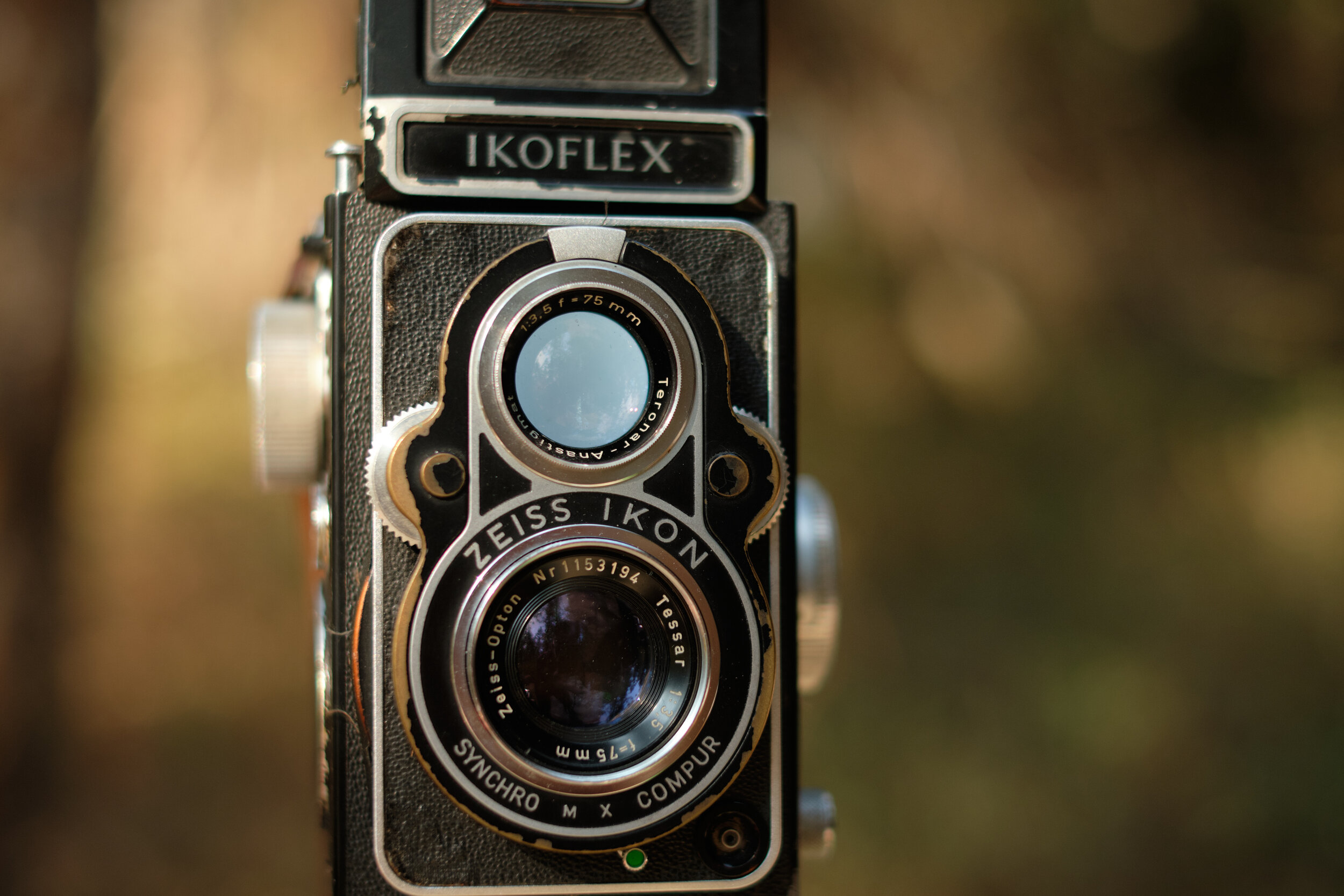
Zeiss-Opton Tessar 75mm f/3.5 lens on the Zeiss Ikon Ikoflex
On to Leo's Camera to buy film. I picked up a roll of Kodak Tri-X 400 black-and-white negative film and a roll of Kodak Portra 400 color negative film. It had probably been 15 years since I last spent money on anything from Kodak.
The guys at Leo's were super friendly: Chris, Jeff, and Jack. I had them help me load the first roll, and as we hovered around the camera, there was no shortage of remarks like "Where is the LCD?” and "How many shots can you get per battery?”
The lens of a 60+ year old Zeiss Ikon Ikoflex
Kodak Tri-X 400
I had the first roll developed and scanned at Rocket Reprographics on West Cordova in Vancouver. My first roll was a Tri-X 400. The scans were 1500 x 1500 pixels from the 120 film format. The scans were okay for viewing on my laptop, but I knew I could get better quality by scanning them myself or copying the negatives with my Fujifilm X-Pro2 and a macro lens.
For the photos in this post, I copied the slides using my Fujifilm X-Pro2 with an AF Micro-Nikkor 60mm f/2.8D lens and a Skier Sunray Copy Box 3 with the 120 film holder. The X-Pro2 RAW files have been converted using the Negative Lab Pro plugin for Lightroom.
Check these posts on the topic of copying negatives:
Copying negatives with Skier Sunray Copy Box
Converting negatives using Negative Lab Pro
Focusing: The waist-level viewfinder on the Zeiss Ikon Ikoflex is not the easiest to work with. Getting things in focus takes practice or a bit of luck. There is a magnifying loupe you can pull up from the front of the viewfinder for accurate focusing, which does help.
The focusing dial on the side of the Zeiss Ikon Ikoflex
I have made minor adjustments in Negative Lab Pro, and level/tone/white balance adjustments in Lightroom and Photoshop.
Dust spots were removed in Photoshop using the spot healing brush tool. The files do need some cleanup, but nothing more than I expected, and the spot-healing brush tool is a magical work of art and easy to use.




Shooting Sports With a Zeiss Ikon Ikoflex
As I dropped off my first roll of film in Gastown for development, I had forgotten about the Gastown Grand Prix bicycle race taking place that day. So here I was with a Zeiss Ikon Ikoflex TLR camera and a roll of Kodak Portra 160.
I had twelve frames to play with. Manual focus. And no, I could not shoot at 8 frames per second, as I otherwise would have with my digital Fujifilm X-Pro2. The film would have been used up in a second and a half.
Exposure: The Zeiss Ikon Ikoflex is fully manual. You set your shutter speed and f-stop on the dials beside the lenses. There is no light meter. I have been using a Sekonic L-358, or sometimes I estimate the exposure using my X-Pro2.
The fastest shutter speed on the Zeiss Ikon is 1/250th of a second, and I am not sure of the accuracy. Not ideal for sports, but hey, why not shoot the roll and see what would happen?
As I put this second roll of film in the camera, it felt like something was wrong. I was at the first frame, but the shutter would not trigger. So I kept winding the film a bit longer till I realized something was certainly not right. So I reset the counter back to 1, and now the shutter worked. But I had wasted three precious frames.
The film advance dial, shutter button, and frame counter reset button on the Zeiss Ikon Ikoflex
I am glad I did not have a photo editor waiting for my results. With this roll, I encountered the problem I had earlier. The frames overlapped, which meant cropping them in Lightroom.
Note: It is important to reset the counter as soon as the film is in the camera and the first frame is reached. Otherwise, the shutter will not trigger. Not doing this may also be the cause of my overlapping frames issue, but I cannot say for certain.


I had fun working around the limitations and enjoyed slowing down completely and carefully picking my vantage points. The lighting was tricky in the late afternoon with harsh sunspots between the darkening streets. I was using a Sekonic L-358 light meter to dial in my exposure.
At the race, I met a photographer who, with a big smile, asked me what the heck I was doing. We had a nice chat about film photography.
Another photographer was trying out his Fujifilm GFX 50s medium-format digital camera for sports. I told him the Zeiss Ikoflex was my new GFX. He smiled and continued shooting. He had more than twelve frames to work with.
Loading film with the Zeiss Ikon Ikoflex. See the steps below.
Loading Film With the Zeiss Ikon Ikoflex
Take the bottom film spool from the old film and move it to the top slot.
The black part of the film must face the lens.
Attach the film to the top film spool. Make sure it’s attached properly.
Close the camera back.
Wind the film to the first frame. At the bottom of the camera, there is a small window you can open and view how far you have forwarded the film. Look for the indicators on the film roll.
Reset the counter by rotating the frame counter dial counterclockwise. When you reach 1, you should feel a slight click. Now you should be able to fire the shutter.

English Bay Beach and Condos. Zeiss Ikon Ikoflex, Ilford FP4
Fujifilm Acros II
Fast forward two to three years, and the Zeiss Ikon Ikoflex kept looking at me from the shelf, and the urge to shoot analog hit me again. This happened at the same time as I finally decided to begin copying some of my old negatives, and some of my Dad’s old negatives inspired me to start shooting film again.
I had a Fujifilm Acros II black-and-white film kicking around and decided to pick up a Kodak Ektar 100 color negative film as well for a camping trip to the Okanagan.
The Kodak Portra 400 roll I mentioned above was a complete mishap. Not a single frame came out in development. I am still not sure if it was the guy operating the camera or perhaps the film advance issue is very real.
I had fun shooting during the camping trip, but unfortunately I only got about 7 frames from the roll, and again, I had overlapping frames. This does indeed hurt, and there was one frame in particular for which I really had high hopes.


Kodak Ektar 100
The Kodak Ektar 100 roll has been my most successful to date. I came home with 11 frames out of 12. Perhaps I have finally nailed the film insert, advance, and overlap issues. I cross my fingers. Here are a couple of frames from the camping trip and a couple from Vancouver’s West End.


Zeiss Ikon Ikoflex Conclusions
There is a lot of nostalgia involved for me when I pick up the Zeiss Ikon Ikoflex, as this was my dad’s camera. This also means I am forgiving its faults.
The more I use it, the more I get the hang of it, and I hope some of the issues I have encountered are operator errors and have nothing to do with the camera.
Shooting in 120 film has inspired me to pursue medium-format photography further. Despite the age and faults of the Ikoflex, the results can be fantastic when you nail focus and exposure. I especially like the black-and-white images.
I find the imperfections and signature from the past in the Zeiss glass from the mid-fifties quite appealing. I may dedicate the Zeiss Ikon Ikoflex to black-and-white and try a few film stocks to find a favorite.
The Zeiss Ikon Ikoflex
Cost of the Zeiss Ikon Ikoflex and Alternatives
I have a later-model Ikoflex IIa 855/16, produced by Zeiss Ikon in Germany from 1951 to 1958. I did a quick search on eBay. Depending on the condition of the camera, you can find the Ikoflex IIa for around $200.00 - $700.00.
There are plenty of alternatives if you are in the market for a TLR Camera. If you are looking for something newer and perhaps more reliable but still affordable, check out the Yashica Mat 124G. If you have deeper pockets and dare to look, check out the plethora of Rolleiflex options. One day, perhaps.
Zeiss Ikon Ikoflex
So far, shooting film rather than digital has revealed benefits I had not considered. I am getting in better shape with this project. I have cycled back and forth to the repair place twice, to Leo's Camera three times, to Rocket Reprographics twice, and to The Lab three times.
I hope you enjoyed the story of my Dad’s Zeiss Ikon Ikoflex. Stay tuned for more film photography coming up. Please do not hesitate to drop me a comment or question below.
Update:
I have now had a chance to compare my Zeiss Ikon Ikoflex to a Hasselblad 503CX. Please follow the link here to my review:
Hasselblad 503CX - Film Camera Review
Update: April 2022:
I have had the Zeiss Ikon Ikoflex repaired again to address the overlapping film issue. I just got my first film back after the repair and can happily report that the problem appears to have been fixed. I got 12 perfect keepers out of 12.
Relevant Reviews
See all my reviews at a glance: